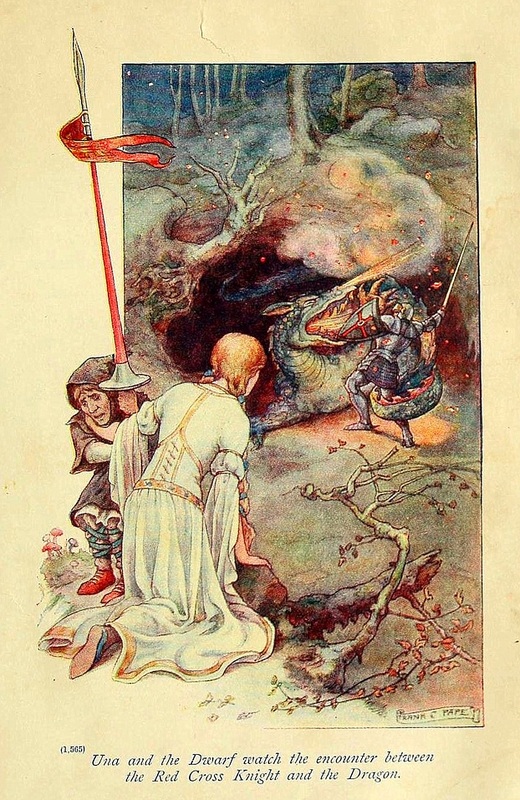
Allegory has fallen out of style in today’s poetry but it is a form that we very much need to recover. It shapes imaginations so people can see the deeper truths that God has stitched into the fabric of the world. Edmund Spenser understood this powerful tool and he gives us a great example as we seek to recover a Christian imagination.
Allegory is based on the idea that the world is not merely physical but also spiritual. This deeper reality holds all creation together. This also makes our world an allegory. Allegory uses names and characters as highly symbolic figures to reveal the spiritual dimension of the world. This form is a kind of extended personification where spiritual realities become characters to interact with. Allegory asks the bold question: what if your heart could talk? That is, what if your fear, envy, love were people that would talk to you? What would those kinds of characters do and say?
This form of poetry is apocalyptic. That is, it puts distance between the person and his desires which allows us to see the desire in its proper light. You can only see the forest when you step outside the forest. C.S. Lewis describes allegory as psychomachia: the war of the spirit. (1) One key example of allegory that is still with us is when a character in a cartoon is considering a course of action and he has a demon on one shoulder and an angel on the other shoulder. These two characters try to persuade him to do one of two actions. This form reveals the depths of the human heart in a way that other forms do not.
In allegory the characters can also embody spiritual ideas like charity, temperance, hope, and more. These kinds of stories allow us to look more directly at these virtues and see them as living characters. This form helps our imagination grasp these realities by seeing them lived out as characters in the story rather than mere abstractions.




 Jesse Sumpter