
The cyclical nature of time is troubling to modern thinkers. It suggests that we are trapped in a reality that is beyond our control. We are born and then we die and there is nothing we can do about it. The sun rises and the sun sets. Seasons come and go. It is common to find stories that view the repetition of time as meaningless. If things happen again the way they happened before, why have hope? No matter what happens, it will happen again.
However, the cyclical nature of time does not have to be meaningless. Recognizing that God made the world run in cycles enables us to gain knowledge about the world and to live faithfully in time because we can see the patterns in the past and find the patterns in our own lives. In this way, the cyclical nature of time gives hope.
Cyclical Time in Literature
Many works of literature in the twentieth century reflect on the cyclical nature of time: The Stranger, The Sun Also Rises, The Great Gatsby, and Animal Farm. These particular stories focus on the futility of repeated events. Animal Farm closes in a poignant way: “No question, now, what had happened to the faces of the pigs. The creatures outside looked from pig to man, and from man to pig, and from pig to man again; but already it was impossible to say which was which.” (p. 141)

Animal Farm began with a hopeful vision of the future: the animals on the farm were living under the rule of the famer, Mr. Jones, but the animals were looking to break free from the oppression of man. They achieve something of this independence and drive Mr. Jones off the farm. But over the course of the story, the pigs gain control and the beasts are put back in their place on the farm with the pigs finally turning into men. By the end of the work, the animals are back again where they started.
To return to the place you started is to suggest that your actions were futile.
The cycle of the story highlights the futility and meaninglessness of the actions of the animals. Their efforts were meaningless. They ended up where they started. To return to the place you started is to suggest that your actions were futile. You went somewhere and you returned. Why did you even set out if all you were going to do was return?
Albert Camus and Meaningless Repetition
The Postmodern worldview holds to the hopeless nature of circular time. Gene Edward Veith writes, “The blind automatic order of nature and the logical conclusions of rationalism may be orderly, but they are inhuman. As far as a human being is concerned, the mindless repetitions of natural laws are meaningless.” (p. 37) The Postmodern mind is disturbed by the laws of nature because they hinder the individual and his desire to create his own meaning. They see the laws of nature as a machine grinding up people in the cranks and wheels of fate.
The Postmodern mind is disturbed by the laws of nature because they hinder the individual and his desire to create his own meaning.
Some writers, however, attempt to push back on this hopeless situation. Albert Camus does this in his interpretation of the Myth of Sisyphus. In this writing, Camus does not reject the oppressive nature of cyclical time. Rather, he claims that man can find happiness even in the face of mindless repetition.
Camus writes, “At each of those moments when [Sisyphus] leaves the heights and gradually sinks toward the lairs of the gods, he is superior to his fate. He is stronger than his rock.” (p. 89) In that moment when Sisyphus goes back down the hill, Camus claims to have found a hidden hope. The repetition of pushing the rock might seem meaningless but Sisyphus, in choosing to go back down and doing it again, can claim to be happy. Camus says, “The struggle itself toward the heights is enough to fill a man’s heart. One must imagine Sisyphus happy.” (p. 91)
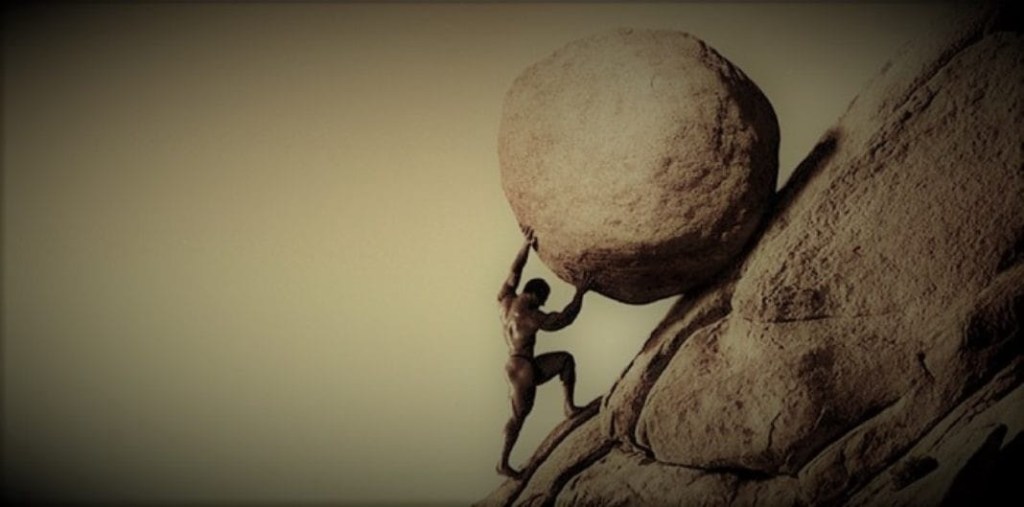
What is Camus getting at here? He is arguing that it is actually defiant for Sisyphus to do the mindless task in joy. Rather than the gods cursing him to do this drudgery, Sisyphus says he likes it. Camus is essentially saying that the punishment ceases to be a punishment when Sisyphus chooses for himself the fate of rolling the rock. To put it in another context, it is like the boss firing the employee. What can the employee do to retaliate? He can say, “You can’t fire me, I quit!” The same is true for Sisyphus who says to the gods: “You can’t make me suffer with pushing a rock up a hill, I like it! In fact, I choose to do it every day for the rest of my life!”
Camus is essentially saying that the punishment ceases to be a punishment when Sisyphus chooses for himself the fate of rolling the rock.
Camus connects this myth to the common worker. He says, “If this myth is tragic, that is because its hero is conscious. Where would his torture be, indeed, if at every step the hope of succeeding upheld him? The workman of today works everyday in his life at the same tasks, and his fate is no less absurd.” (p. 90) Camus says that the punishment of Sisyphus is a picture of man’s life locked in toiling every day without end.
Repetition Is Hope
In the Christian worldview, the reality of repetition in the world does not necessitate hopeless fate. There is a hidden assumption in modern thinking that we must question. G. K. Chesterton puts his finger on it when he writes, “All the towering materialism which dominates the modern mind rests ultimately upon one assumption; a false assumption. It is supposed that if a thing goes on repeating itself it is probably dead; a piece of clockwork.” (p. 69)
Simply because something happens again doesn’t mean it is mindless.
Why assume that repetition is meaningless? Simply because something happens again doesn’t mean it is mindless. Rather, repetition is evidence of meaning. A mother bird leaves her nest for food and returns because she has dinner for her family. She does this each day because she is alive. A dead bird does not bring home dinner each night. Things that are dead do not repeat.
The sun rises and the sun sets because it is alive. God is active and engaged in reality and we see it every morning. The repetitions we see in time, history, and seasons are because God is telling a story and He is an engaging storyteller. The patterns we see in the world is one of the ways that we know God is in charge. He loves telling the same kinds of stories over and over again. The world is full of patterns and God has made it this way so we can learn the patterns and learn how to live in line with the patterns.




 Jesse Sumpter